FPSC has published the official syllabus for the Assistant Audit Officer (BS-17) screening test. The syllabus appeared with the FPSC syllabus document for Consolidated Advertisement No. 4/2026 on 11 November 2026, and it settles the question every candidate for these 160 posts has been asking since the advertisement opened on 6 November: exactly what will be tested, and how much each part counts. Applications close on Monday, 23 November 2026, and the test is tentatively scheduled from 2 January 2027 — so there are about seven weeks between the closing date and the test.
The post at a glance
- Post: Assistant Audit Officer (BS-17), Office of the Auditor General of Pakistan
- Vacancies: 160 (permanent), posting anywhere in Pakistan
- Advertisement: FPSC Consolidated Advertisement No. 4/2026, Case No. F.4-195/2026-R
- Last date to apply: Monday, 23 November 2026 (online only, at fpsc.gov.pk)
- Fee: Rs 600, paid through the PSID generated on the FPSC portal, via 1-Link
- Test: tentatively from 2 January 2027
- Age limit: 22 to 30 years, plus five years general age relaxation (maximum 35)
Who can apply
A second class or Grade 'C' Master's degree in Business Administration (Finance/Accounting), Economics, Mathematics, Commerce or Statistics, or an equivalent qualification from an HEC-recognised university. Master's degree holders in other disciplines can also apply if they hold an ICMA one-year postgraduate certificate, CA Foundation, or ACCA knowledge level. Bachelor's degree holders can apply if they are PIPFA (Public Sector) or SAS qualified and have three years of relevant service. Selected candidates are confirmed only after passing the SAS / PIPFA (Public Sector) examination. Government servants need a Departmental Permission Certificate before applying.
The official test pattern
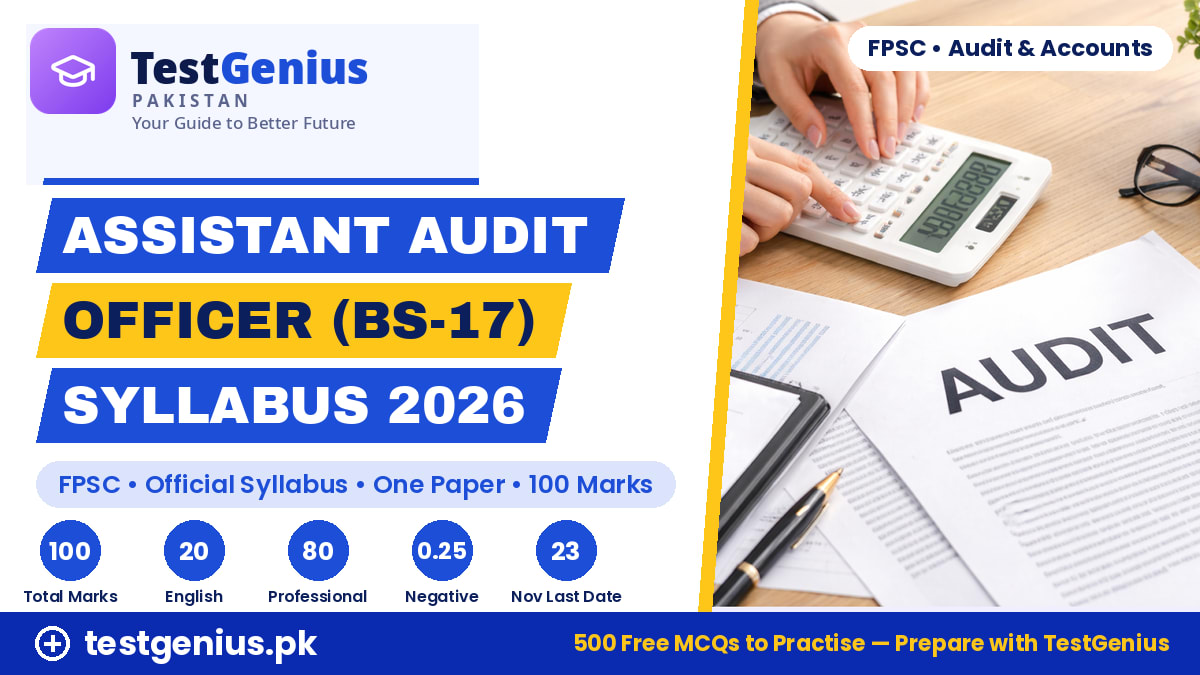
One objective (MCQ) paper of 100 marks. You need 40 per cent to pass, and each wrong answer costs 0.25 marks — so guessing across the whole paper will hurt you, and the paper rewards accuracy over attempts. Part I — English: 20 marks. Part II — Professional Test: 80 marks. The shortlist for interview is drawn from those who pass the test. The interview carries 200 marks, and the qualifying mark for BS-17 posts is 101. Final merit is based on the total of your written test and interview marks.
Part I — English (20 marks)
Vocabulary; Grammar Usage; Sentence Structuring. Twenty marks is a fifth of the paper, and it is the part most commerce graduates under-prepare for. It is also the most predictable: synonyms and antonyms, correct prepositions, and choosing the grammatically correct sentence. A daily set of 20 English MCQs, with every mistake written down and revised, is worth more here than a grammar book read once.
Part II — Professional Test (80 marks)
This is where the paper is won. The official syllabus lists:
- Financial accounting — the accounting cycle, journal, ledger, trial balance, adjustments and final accounts
- Partnership and company accounts; valuation of goodwill and shares
- Analysis of financial statements and ratio analysis
- Cost and management accounting — costing methods, budgeting, budgetary control and variance analysis
- Auditing — scope and objectives, types of audit, audit programme, audit evidence and working papers
- Verification of assets and liabilities; rights, powers, duties and liabilities of the auditor
- Public sector auditing — financial attest audit, compliance audit and performance audit; International Standards of Supreme Audit Institutions (ISSAIs)
- Constitutional provisions relating to the Auditor General of Pakistan (Articles 168 to 171 of the Constitution)
- Planning, conduct and reporting of audit; the role of Public Accounts Committees in public accountability
- Public sector accounting — cash and accrual basis, and International Public Sector Accounting Standards (IPSAS)
- The Public Finance Management Act, 2019, and the Public Procurement Rules
- Internal controls, investigation of accounts and detection of fraud; IT audit and computer assisted audit techniques
- Economy of Pakistan — budget, taxation and fiscal issues
- Public sector accountability and transparency
If you studied commerce or accounting, most of this is revision, not new learning. The new ground for most candidates is the public-sector half: the Constitution's audit provisions, ISSAIs, IPSAS, the Public Finance Management Act and the procurement rules. Give that half the larger share of your time, because it is also the half your competitors are most likely to neglect.
A 7-week preparation plan
The test is tentatively set for 2 January 2027. Counting from the 23 November closing date, that gives you about seven weeks of serious preparation.
Week 1: Financial accounting, end to end. Journal to final accounts, with adjustments. Work problems, do not just read them — the paper tests whether you can apply the cycle, not whether you remember its definition.
Week 2: Partnership and company accounts, goodwill and share valuation, then financial statement analysis and ratios. Learn each ratio's formula and what a high or low value actually means.
Week 3: Cost and management accounting. Costing methods, budgets, budgetary control and variances. This is the most numerical part of the paper; practise until the workings are automatic.
Week 4: Auditing — the core of the post. Types of audit, audit programmes, evidence, working papers, verification of assets and liabilities, and the auditor's rights and duties.
Week 5: The public-sector half. Articles 168 to 171, ISSAIs, IPSAS, the Public Finance Management Act 2019, procurement rules, Public Accounts Committees, and internal controls and fraud detection.
Week 6: English plus the Economy of Pakistan. Twenty English MCQs a day, and a revision pass over the budget, taxation and fiscal issues.
Week 7: Full-length practice. Sit 100-MCQ papers in 100 minutes, with the 0.25 negative marking applied, and review every wrong answer the same day. Do not start a new book in this week.
One rule for the whole seven weeks: attempt only what you can justify. With negative marking at 0.25, a guessed answer needs to be right more than once in five tries to be worth it. Leave the question if you cannot eliminate at least two options.
Practise with TestGenius
Comments
Loading comments…