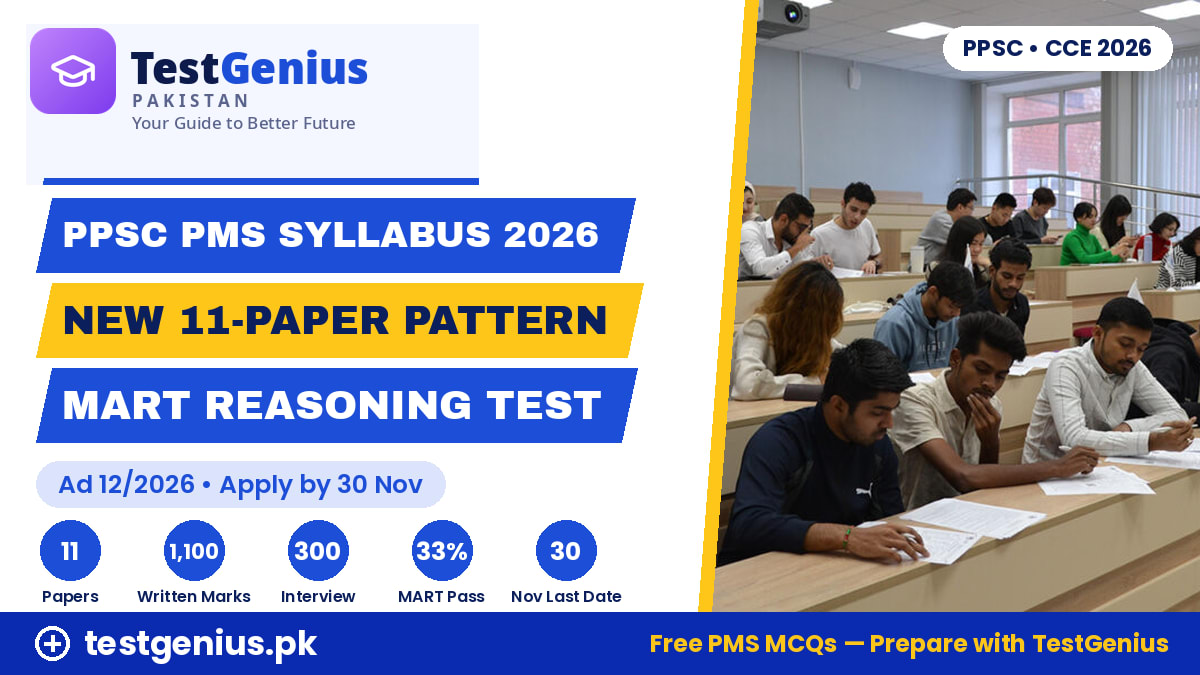
PPSC has rebuilt the Provincial Management Service examination for 2026, and candidates who prepare from the old six-paper pattern will be preparing for the wrong exam. Advertisement No. 12/2026 (Case No. 106-RC/2026) announces 48 BS-17 posts — 45 Provincial Management Service officers, 1 Excise & Taxation Officer and 2 Assistant Directors Local Fund Audit — under a new 11-paper scheme worth 1,100 written marks plus a 300-mark interview. Applications close on 30 November 2026, and the written examination follows the new syllabus only.
The new pattern at a glance: what changed
- Ten compulsory papers worth 1,000 marks, plus one optional paper worth 100 marks. Written total 1,100; interview 300; grand total 1,400.
- The old pattern had six compulsory papers (600 marks) and three optional papers (600 marks) — written total 1,200, interview 200.
- The biggest change is Paper II, a new 100-MCQ Mental Ability & Reasoning Test (MART), with a 33% qualifying bar and −0.25 negative marking.
- The interview has grown from 200 to 300 marks, so the viva now decides more than a fifth of the final merit.
- Age limit: 21 to 32 years for general candidates under a one-time S&GAD dispensation for the 2026 and 2027 cycles (previously 30), with 4 attempts instead of 3. Government servants with at least 4 years of service can apply up to 35 years; special persons up to 45 years. Age is counted as on 1 January 2027. Minimum qualification is a second-division graduate degree from an HEC-recognised university, Punjab domicile.
Paper by paper: all 11 papers
- Paper I — General Knowledge (100 marks): MCQ paper, −0.25 negative marking.
- Paper II — Mental Ability & Reasoning Test (100 marks): MCQ paper, −0.25 negative marking, 33% qualifying threshold. Covers logical and analytical reasoning, quantitative and numerical processing, reading and verbal comprehension, and decision-making and problem-solving.
- Paper III — English Essay (100 marks): subjective, one essay.
- Paper IV — English, Precis, Comprehension, Grammar & Translation (100 marks): subjective.
- Paper V — Urdu, Essay, Precis, Comprehension, Grammar & Translation (100 marks): subjective.
- Paper VI — Islamic Studies, or Ethics for non-Muslim candidates (100 marks): 25 marks MCQs + 75 marks subjective.
- Paper VII — Pakistan Studies-I (100 marks): 25 marks MCQs + 75 marks subjective.
- Paper VIII — Pakistan Studies-II (100 marks): 25 marks MCQs + 75 marks subjective.
- Paper IX — International Affairs (100 marks): 25 marks MCQs + 75 marks subjective.
- Paper X — Economy and Development (100 marks): 25 marks MCQs + 75 marks subjective.
- Paper XI — One optional subject (100 marks): subjective, chosen from 30 approved subjects. The choice is final — the advertisement allows no change after submission.
Qualifying marks: the numbers that decide
- Paper II (MART): at least 33% — and PPSC notes this threshold may be revised after the exam on statistical analysis.
- Every other written paper: at least 40% (40 out of 100).
- Written aggregate: at least 50% — 550 out of 1,100 — to reach the psychological assessment and interview.
- Interview: at least 50% — 150 out of 300 — to enter the final merit list.
- A candidate absent in any single paper is not allowed to sit the remaining papers. Negative marking of 0.25 applies only in Papers I and II.
The 30 optional subjects — and why the choice matters less now
The 30 approved optional subjects are: Agriculture, Arabic, Botany, Business Administration, Chemistry, Commerce, Computer Science, Economics, Education, Engineering Fundamentals & Engineering Management, English Literature, Geography, Geology, History, Law, Mass Communication, Mathematics, Persian, Philosophy, Physics, Political Science, Psychology, Public Administration, Punjabi, Social Work, Sociology, Statistics, Urdu, Veterinary Science and Zoology. The detailed syllabus of each optional subject is on
https://www.ppsc.gop.pk .
Under the old pattern, three 200-mark optionals could swing merit by themselves. Now the single optional is worth only 100 of the 1,100 written marks, so it cannot rescue weak compulsory papers. Choose the subject you already know best — ideally one that overlaps with your degree or with Papers VII–X — and put most of your hours into the compulsory papers.
How to prepare: where the marks actually are
- 325 of the 1,100 written marks are MCQs: Papers I and II are fully objective (200 marks), and Papers VI–X carry 25 MCQ marks each (125 marks). Daily MCQ practice on general knowledge and reasoning is the highest-return habit in this exam. Practise with TestGenius: PPSC PMS Screening (500 MCQs), General Knowledge, English, Pakistan Studies and Islamic Studies.
- English decides two full papers (Essay and Precis) plus the comprehension inside Paper II, so write one essay and one precis every week and get them checked.
- Pakistan Studies is now two papers, not one, and International Affairs and Economy & Development are standalone papers — read the newspaper daily and keep short notes on the economy, the budget, trade and foreign policy.
- Do not wait for the exam date: PPSC has not announced the written-exam date in the advertisement. Prepare to the syllabus now; the date will be announced on https://www.ppsc.gop.pk .
How to apply (48 posts, last date 30 November)
- Apply online only at ppsc.gop.pk by 12:00 midnight on 30 November 2026. No hard-copy or late applications are accepted, and the optional subject and exam-centre choices cannot be changed after submission. Read the full advertisement (No. 12/2026, Serial No. 191, Case No. 106-RC/2026) on ppsc.gop.pk before applying — including the application fee, which is set in the advertisement itself.
- Related: the live job post for these 48 posts is on TestGenius, with the full post breakdown
Comments
Loading comments…