The Federal Public Service Commission announced the result of the CSS MCQ-Based Preliminary Test (MPT) for the Competitive Examination 2027 on 4 November 2026. The test itself was held on 10 October 2026, after being moved from its original date of 27 September. If you sat the MPT, the next two weeks decide whether you move forward: only candidates who qualified in the MPT can apply for the written examination, and the online application window runs from 10 to 25 November 2026.
How to check your CSS MPT 2027 result
FPSC has published three separate lists on its website, fpsc.gov.pk — passed, failed and withheld. There is no CNIC-based lookup. Open the Results section on the FPSC website, download the list that applies to you and search for your roll number. Do not trust any third-party site that claims to show your result from your CNIC; FPSC publishes results on its own website only.
A pass in the MPT is a qualifying step, not a merit position. MPT marks do not count towards your final CSS merit, and sitting the MPT does not consume one of your written examination attempts. An attempt is counted only when you sit a paper of the written examination. The pass is also valid for this cycle only — it cannot be carried to CSS 2028.
The MPT, in brief
The screening paper was one paper of 200 multiple-choice questions in 200 minutes, covering English, General Science and Ability, General Knowledge, Pakistan Affairs, Current Affairs, Islamic Studies or Civics, and Urdu. The qualifying mark was 33 per cent — 66 out of 200 — with no negative marking.
Applying for the written examination
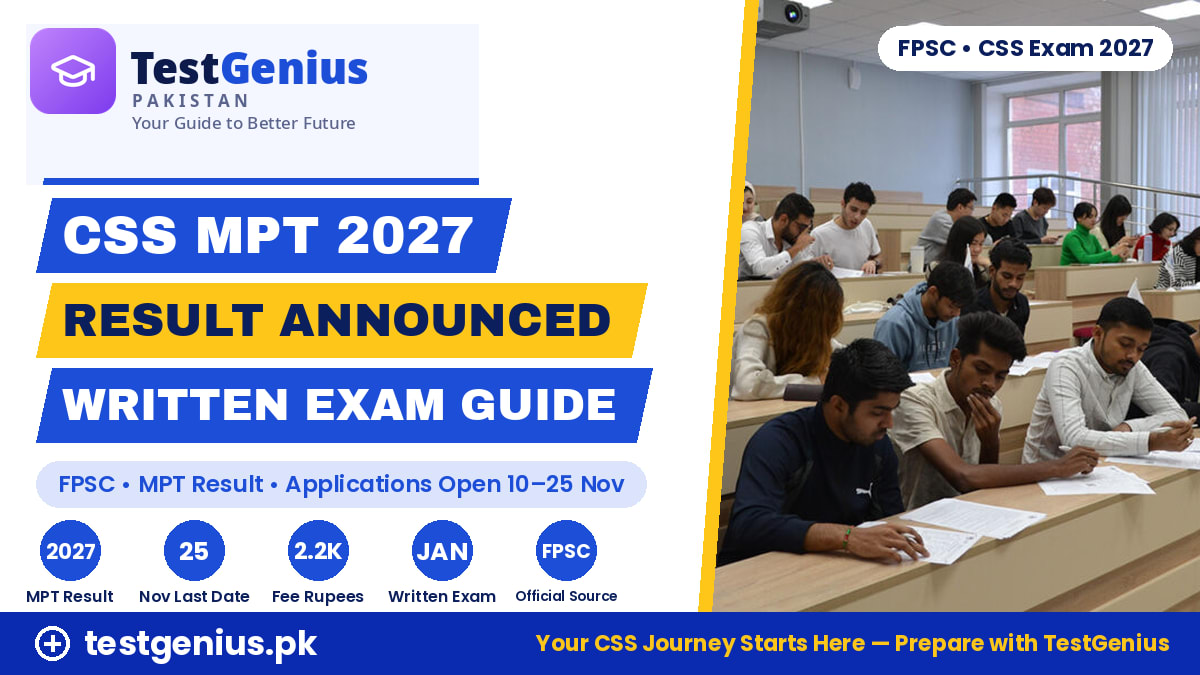
Only MPT qualifiers can apply. FPSC's public notice No. F.2/1/2026-CE, dated 8 November 2026, sets out the following: online applications 10 to 25 November 2026, through fpsc.gov.pk only; fee Rs 2,200; signed hard copy with attested documents must reach FPSC by 4 December 2026; written examination tentatively from 27 January 2027, in 19 cities across Pakistan; eligibility cut-off age 21 to 30 years as on 31 December 2026.
Read the 8 November public notice itself before you apply. It is the binding document, and every written-exam date in it is labelled tentative until FPSC confirms the final schedule. Late or incomplete applications are rejected, so do not leave the hard copy to the last day — post it with time to spare and keep the receipt.
What the written examination looks like
The written stage is 12 papers carrying 1,200 marks in total: six compulsory papers and six optional papers. The compulsory papers are English Essay, English (Precis and Composition), General Science and Ability, Current Affairs, Pakistan Affairs and Islamic Studies (or Comparative Study of Major Religions for non-Muslim candidates). Your optional subjects, chosen now, cannot be changed after submission, so pick subjects you can actually sustain for eleven weeks of preparation, not the ones that merely sound impressive.
A realistic plan from now to 27 January
You have roughly eleven weeks. That is enough to build a pass, but only if the work is daily and written, not just read.
Weeks 1–2: Fix your optionals and gather your material. Read the syllabus of every paper you have chosen, collect past papers from 2016 onwards, and write one essay outline a day. Start a daily current affairs notebook — one page a day, in your own words, from Dawn and one international source.
Weeks 3–6: The heavy middle. Write one full essay a week under timed conditions and get it checked by someone who will mark it honestly. Practise precis every other day; it is the paper that quietly fails good candidates. Cover Pakistan Affairs and Islamic Studies in short daily sittings rather than long weekend blocks.
Weeks 7–9: Past papers in exam conditions. Sit full papers, timed, without notes. Mark yourself against the marking schemes and keep a list of the topics that keep costing you marks. This is also the time to revise General Science and Ability, which rewards short, regular MCQ practice more than long reading sessions.
Weeks 10–11: Revision only. No new books. Re-read your own notes, your essay outlines and your current affairs notebook. Sleep properly in the final week; the written examination is a test of endurance as much as knowledge.
Throughout, keep a daily MCQ habit going. Short practice sets in current affairs, Pakistan affairs and general knowledge keep the facts fresh for the papers where a single precise fact can lift an answer.
Practise with TestGenius
Comments
Loading comments…