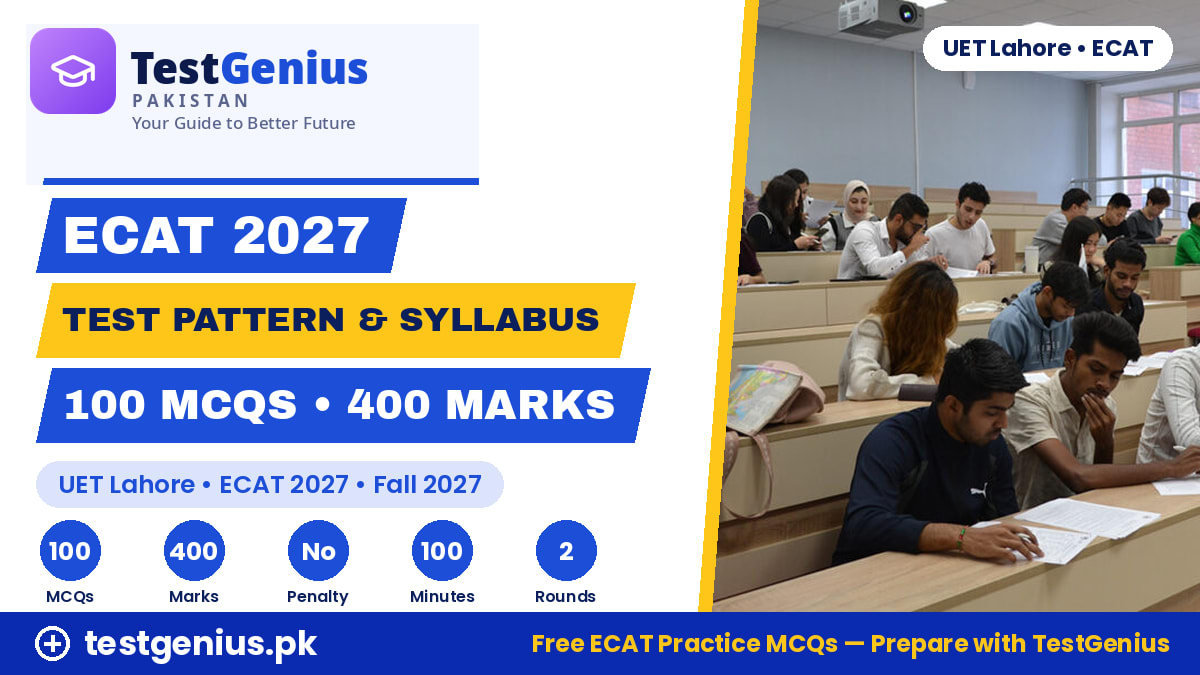
ECAT 2027 is UET Lahore's e
ntry test for engineering and computing programmes in Punjab. It is 100 MCQs in 100 minutes for 400 marks, with no negative marking. The 2027 dates are not announced yet — check ecat.
uet.edu.pk — but the pattern and syllabus follow the FSc Part I & II course.
ECAT 2027 at a glance
The Engineering College Admission Test (ECAT) is conducted by the University of Engineering and Technology (UET) Lahore for admission to public-sector engineering institutions in Punjab, under the supervision of the Pakistan Engineering Council. The test is 100 multiple-choice questions in 100 minutes — one minute per question — for 400 marks, with 4 marks for each correct answer. There is no negative marking: wrong and blank answers earn 0, so attempt every question. The test is computer-based and held at centres across Punjab. UET holds two rounds a year and your best score counts for merit.
Paper pattern — subject weightage
Mathematics or Biology: 30 MCQs, 120 marks, 30%. Physics: 30 MCQs, 120 marks, 30%. Chemistry, Computer Science or Statistics: 30 MCQs, 120 marks, 30%. English comprehension: 10 MCQs, 40 marks, 10%. Your combination depends on your Intermediate subjects: Mathematics–Physics–Chemistry; Mathematics–Physics–Computer Science; Mathematics–Statistics–Computer Science; Biology–Physics–Chemistry; or Mathematics–Statistics–Physics. English is 10 paragraph-comprehension questions.
Syllabus — the full FSc course
The ECAT syllabus covers the complete FSc Part I and II course — there is no selective topic list, so every chapter in your Intermediate textbooks is fair game. Mathematics: functions and limits, differentiation and its applications, integration, analytic geometry, vectors, sequences and series, matrices and determinants. Physics: measurements, vectors and equilibrium, motion and force, work and energy, circular motion, waves and optics, thermodynamics, electrostatics, current electricity, electromagnetism, electronics and modern physics. Chemistry: atomic structure, chemical bonding, thermodynamics, equilibrium, kinetics, electrochemistry and organic chemistry. Computer Science and Statistics replace Chemistry for the relevant combinations. English: reading-comprehension passages, contextual vocabulary, sentence correction and prepositions.
Merit formula — FSc matters most
UET merit is 50% FSc + 33% ECAT + 17% Matric. Your FSc result carries the most weight, so board-exam performance matters as much as the entry test. Eligible students are those who have completed or are appearing in FSc Pre-Engineering, ICS with Mathematics and Physics, a relevant three-year DAE diploma, or equivalent A-levels. The ICS computing stream needs a minimum of 60% marks.
2027 dates — not announced yet
UET has not released the 2027 ECAT schedule yet — check ecat.uet.edu.pk for the official dates. In 2026 the test was held in two rounds. Academies have already opened ECAT 2027 preparation sessions, so preparation searches are running ahead of the official schedule. Do not trust date sheets circulating on social media — only the UET portal is official.
Preparation plan — eight weeks
Weeks 1–2: revise the FSc Part I and II course chapter by chapter and build a formula sheet for Maths and Physics. Weeks 3–5: chapter-wise MCQ practice with a timer — one minute per question, exactly like the real test. Week 6: full-length mock tests of 100 MCQs in 100 minutes, then review every wrong answer. Week 7: drill your weakest subject — it carries 30% of the paper, so one weak section costs more than English is worth in total. Week 8: light revision, formula sheets and one final mock. Because there is no negative marking, practise answering every question, even by elimination. Practise with TestGenius:
ECAT Mathematics,
Physics,
Chemistry,
English and
Statistics (links in the article).
Comments
Loading comments…