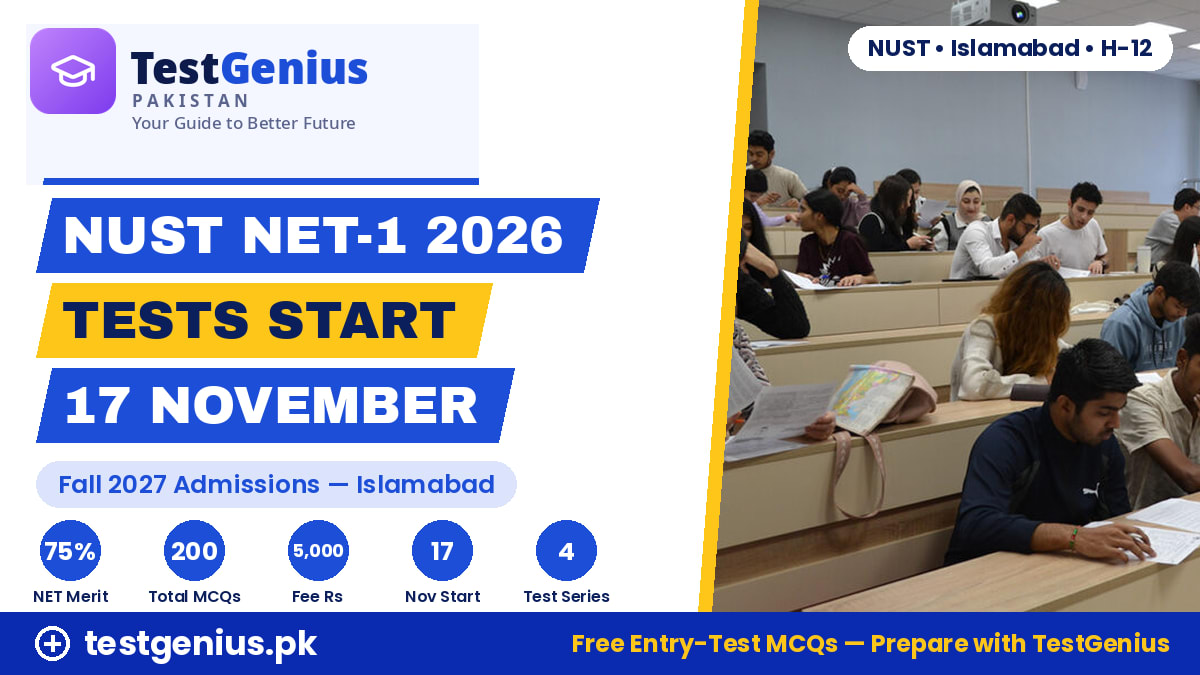
NUST Entry Test (NET) Series-1 — the first test of the Fall 2027 admission cycle — starts on Tuesday 17 November 2026 at the NUST campus in Islamabad (Sector H-12). Registration for this series closed on Friday 14 November, so the candidates sitting from Tuesday are already registered and holding admit cards. The test is computer-based, 200 MCQs in three hours, with no negative marking, and it carries 75% of your NUST admission merit. This guide covers the paper pattern for each NET paper, the merit formula, what to carry to the centre, and what to do if you missed Series-1.
The NET-2027 schedule — four series, best score counts
NUST runs the NET in four series between October 2026 and July 2027. Series-1 registration ran from 4 October to 14 November 2026, and its computer-based tests start in Islamabad on 17 November. Series-2 registration opens in December 2026, with tests from January to March 2027 in Islamabad, Quetta and Karachi; Series-3 follows in February–March and Series-4 in April–May, with the final tests running into July 2027. Every series needs a separate form and a separate fee. NUST follows a best-score policy: if you sit more than one series, your highest NET score is the one used for merit. A NET-2027 score counts for Fall 2027 admission only. NUST marks the whole schedule tentative, so confirm your own date, slot and centre on your admit card and on
ugadmissions.nust.edu.pk before you travel.
Paper pattern — 200 MCQs in 3 hours, no negative marking
Every NET paper is 200 multiple-choice questions in 180 minutes, four options each, with no negative marking — a wrong answer and a blank answer both score zero, so attempt everything. There is no fixed passing mark; admission is decided strictly by composite merit rank. There are five separate NET papers, and your programme decides which one you sit:
- NET-Engineering — for all engineering and computing programmes (including BS Computer Science, Software Engineering, AI, Data Science, Robotics & Artificial Intelligence, Bioinformatics, Mathematics, Physics, Chemistry and Food Science): Mathematics 50% (100 MCQs), Physics 30% (60 MCQs), English 20% (40 MCQs). Chemistry is not in this paper — it was removed in the 2025 restructure.
- NET-Applied Sciences — for Pre-Medical students applying for BS Biotechnology, Environmental Science, Agriculture, Food Science & Technology, Bioinformatics, Chemistry and Physics: Biology 50%, Chemistry 30%, English 20%.
- NET-Business & Social Sciences — Quantitative Mathematics 50%, English 50%.
- NET-Natural Sciences — Mathematics 50%, English 50%.
- NET-Architecture — a separate paper for architecture applicants.
The English section follows the SAT pattern, and the syllabus is drawn from the SSC and HSSC prescribed textbooks. Calculators are strictly forbidden in the hall.
How NUST merit is calculated
Your NUST aggregate is a weighted total, not your NET score alone:
- NUST Entry Test (NET): 75%
- HSSC Part-I / A Level / DAE: 15%
- SSC / Matric / O Level: 10%
For O and A Level candidates still in their A Level final year, the IBCC O Level equivalence carries 25% instead of 10%. Because the NET is three-quarters of your merit, a strong test score can compensate for a weaker board result — and a weak test cannot be rescued by board marks. To apply at all you need at least 60% marks in both SSC and HSSC (or their IBCC equivalents); that is an eligibility floor, not a merit input.
Test-day guide for 17 November onwards
- Check your admit card for your exact day, session and reporting time — NUST assigns each candidate a slot, and Series-1 runs in morning (9:00 AM – 12:00 PM) and afternoon (2:00 PM – 5:00 PM) sessions.
- Reach the H-12 campus early. Carry your admit card and your original CNIC. Without them you are not allowed into the test centre.
- The test is computer-based. You will answer on screen, so practise MCQs on a computer, not only on paper — reading speed on screen and clicking through 200 questions in three hours is a skill of its own.
- With 200 questions in 180 minutes you have about 54 seconds a question. Do not get stuck on one hard question: mark it mentally, move on, and come back if time remains. Mathematics is half of the NET-Engineering paper, so it decides your rank more than any other section.
- No calculators, mobile phones or smart watches are allowed. Bring nothing you cannot leave outside the hall.
If you missed Series-1 registration
Registration for Series-1 closed on 14 November and testing from 17 November does not extend it. If you missed it, you have three more chances in the same cycle: Series-2 registration opens in December 2026, with tests from January to March 2027. Because NUST uses your best score, a later series is not a weaker attempt — many candidates treat Series-1 as a benchmark and improve in Series-2 or Series-3. Each series costs Rs 5,000 per test, and each needs its own form, so plan which series you will sit and register the moment the window opens.
What is new for Fall 2027
Two programmes are new for Fall 2027: BS Robotics and Artificial Intelligence, and BS International Relations. Classes for Fall 2027 start in September 2027, except Aerospace & Avionics Engineering, which starts in October 2027. NUST also accepts ACT or SAT scores for Fall 2027 admission as an alternative to the NET — check the
admissions portal for the current ACT/SAT window if that route suits you.
Practise with TestGenius
Comments
Loading comments…