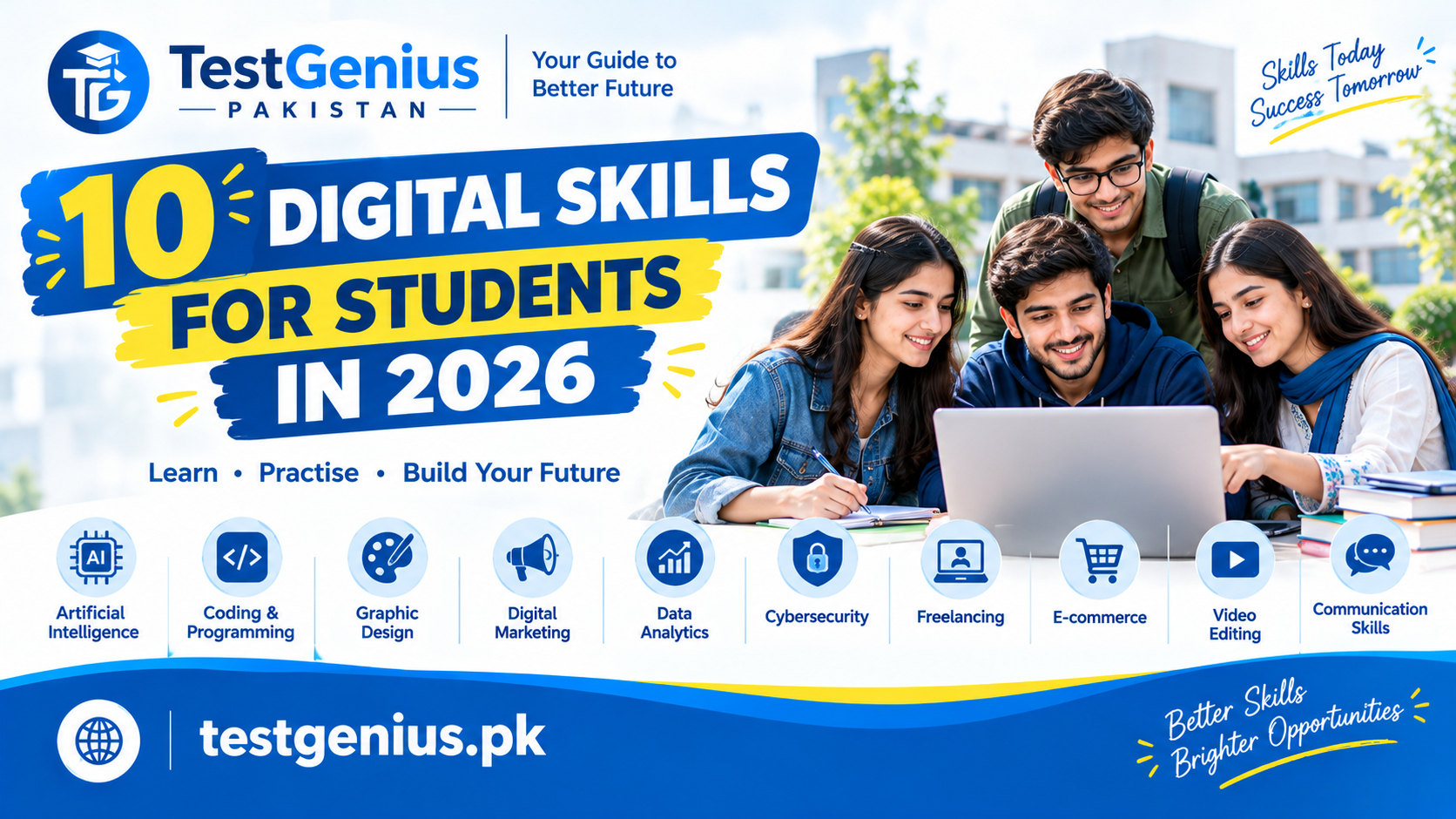
10 Digital Skills Pakistani Students Should Learn in 2026
10 Digital Skills Pakistani Students Should Learn in 2026
A university degree can help you build a career, but practical digital skills can also make a difference. Whether you are in school, college or university, learning how to use technology effectively can help you complete projects, explore internships, prepare for jobs and potentially work with clients online.
In Pakistan, official initiatives such as the Prime Minister’s Youth Programme, NAVTTC and the Higher Education Commission’s Digital Learning and Skills Enrichment Initiative provide routes to explore digital training and online learning. Course availability, eligibility and fees depend on the programme.
Here are 10 useful digital skills worth exploring in 2026.
1. Artificial Intelligence (AI) Literacy
AI tools can help students brainstorm ideas, understand difficult concepts, organize research and improve productivity. Learning to use them responsibly is becoming a valuable general skill.
What to learn:
Writing clear prompts for AI tools.
Checking AI-generated information against reliable sources.
Using AI to organize ideas and support research.
Understanding privacy, copyright and academic integrity.
How to practise: Use an AI tool to help outline a presentation, then verify the facts and write the final work in your own words.
2. Coding and Programming
Programming teaches problem-solving and can lead to opportunities in software development, websites, automation and technology-related careers.
What to learn:
HTML and CSS for basic websites.
JavaScript for interactive web pages.
Python for beginner programming and automation.
Basic debugging and version control.
How to practise: Build a simple personal portfolio website or a small application that solves a real problem.
3. Graphic Design
Businesses, educational institutions and content creators need visual materials for websites, presentations, advertising and digital publications.
What to learn:
Layout, colour and typography.
Social media and web graphics.
Presentation design.
Image editing and basic brand consistency.
How to practise: Create a portfolio containing five original designs, such as a poster, an infographic, a website banner and two promotional graphics.
4. Digital Marketing and SEO
Digital marketing helps businesses reach customers online. Search engine optimization (SEO) focuses on improving the visibility of useful website content in search results.
What to learn:
Keyword research and search intent.
Writing useful website content.
On-page SEO and metadata.
Social media planning and campaign analytics.
How to practise: Create a small website or blog, publish helpful content and learn how to improve its titles, descriptions and internal links.
5. Data Analysis
Data analysis involves organizing information, finding patterns and communicating results. It is useful in business, finance, research, administration and many other fields.
What to learn:
Microsoft Excel or Google Sheets.
Formulas, sorting and filtering.
Charts and dashboards.
Basic statistics and data interpretation.
How to practise: Use a sample dataset to create a spreadsheet and a chart that explains a simple trend.
6. Cybersecurity Awareness
Every student who uses online accounts, email and digital payment services can benefit from understanding basic cybersecurity.
What to learn:
Strong passwords and password managers.
Multi-factor authentication.
Recognizing phishing and online scams.
Safe handling of personal information and files.
How to practise: Review the security settings of your own accounts and learn how to identify suspicious messages. Practise only in systems you own or have permission to test.
7. Freelancing and Client Communication
Freelancing is a way to offer services to clients, but it requires more than knowing a technical skill. Communication, reliability and clear agreements are essential.
What to learn:
Building a professional portfolio.
Writing tailored proposals.
Understanding project requirements.
Setting realistic deadlines and communicating progress.
Agreeing on scope, payment and revisions.
How to practise: Choose one service, prepare three sample projects and write a clear description of what you can deliver.
Remember that freelancing does not guarantee immediate clients or income. Avoid anyone promising guaranteed earnings in exchange for an upfront fee.
8. E-commerce and Online Business
E-commerce involves selling products or services through digital channels. Students can learn how online stores work before investing money in a business.
What to learn:
Product research and customer needs.
Product descriptions and images.
Basic pricing and profit calculations.
Order management and customer service.
Online store fundamentals.
How to practise: Create a sample product catalogue and calculate the costs, selling price and estimated profit for each item.
9. Video Editing and Content Production
Video is widely used in education, marketing, entertainment and online communication. Editing skills can support student projects and creative portfolios.
What to learn:
Trimming and arranging clips.
Adding captions and transitions.
Basic audio cleanup.
Using suitable aspect ratios for different platforms.
Respecting copyright when using music and footage.
How to practise: Make a short educational video using your own footage or properly licensed material.
10. Professional Communication and Productivity
Technical knowledge becomes more useful when you can explain ideas clearly and work reliably with others.
What to learn:
Professional email writing.
Presentation and speaking skills.
Time management and task planning.
Collaboration using online documents.
CV writing and interview preparation.
How to practise: Prepare a professional CV, write a sample job application email and give a short presentation about a topic you know well.
Where Can Pakistani Students Learn These Skills?
Explore these official resources before paying for a course:
1. NAVTTC – Skills and Technical Training
Website: https://navttc.gov.pk/student/
Check the currently listed training programmes, eligibility conditions, course duration and application status. Programme availability can change.
2. Prime Minister’s Youth Programme – Digital Youth Hub
Website: https://pmybals.pmyp.gov.pk/pmyphome/Skills
Explore the available skills and certification resources, which have included areas such as freelancing, e-commerce, graphic design, virtual assistance and technology.
3. HEC Digital Learning and Skills Enrichment Initiative (DLSEI)
Website: https://dlsei.hec.gov.pk/
Explore online learning and professional certificate resources. Access, eligibility and any charges depend on the relevant programme and its current terms.
Always confirm the latest details on the official portal before registering. Not every course is free, and not every programme is open to every student.
How to Choose the Right Skill
You do not need to learn all 10 skills at once. Start with one skill that matches your interests, available time and career goals.
Interested in creative work? Explore graphic design or video editing.
Interested in technology? Start with coding or AI literacy.
Interested in business? Explore digital marketing or e-commerce.
Interested in numbers and research? Try data analysis.
Interested in online services? Combine a specific skill with freelancing and communication.
Give yourself four weeks to explore one skill. Learn the basics, complete a small project, ask for feedback and improve your work. A finished project is more useful than simply collecting course completion certificates.
A Simple 30-Day Learning Plan
Week 1: Choose one skill and study the fundamentals.
Week 2: Follow guided exercises and practise regularly.
Week 3: Complete a small original project that demonstrates what you have learned.
Week 4: Improve the project, organize it in a portfolio and ask a teacher, mentor or knowledgeable peer for feedback.
Adjust the schedule to your studies and responsibilities. Consistent practice is more important than rushing through lessons.
Final Advice for Students
Digital skills can strengthen your education and help you explore future opportunities, but no single course guarantees a job or online income. Focus on genuine ability, practical projects, ethical work and continuous learning.
Start small, use trusted learning resources and avoid expensive courses that promise unrealistic earnings. With patience and regular practice, you can build a foundation for further study, internships, employment or freelancing.
For more education updates, career guidance and student opportunities, visit TestGenius Pakistan at https://testgenius.pk/.
Disclaimer: This article provides general educational guidance. Training programmes, eligibility and access conditions may change; verify current details with the official providers.
Comments
Loading comments…