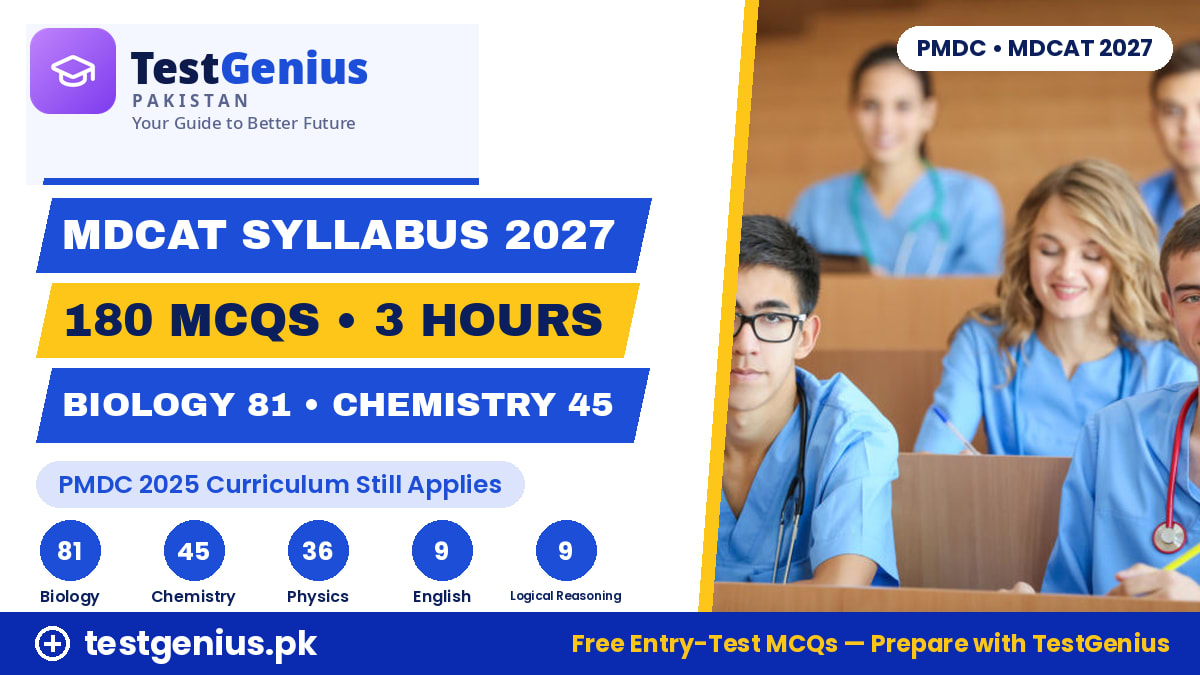
There is no separate MDCAT 2027 syllabus yet. The Pakistan Medical & Dental Council (PMDC) has not published a 2027 curriculum, pattern or date as of November 2026 — and the current official syllabus, the PMDC 2025 Curriculum, was used unchanged for both MDCAT 2025 and MDCAT 2026. So the syllabus to prepare from right now is the one you already have: 180 MCQs in three hours, with no negative marking — Biology 81, Chemistry 45, Physics 36, English 9 and Logical Reasoning 9. This guide breaks down every subject, the weightage that decides your rank, and a preparation plan that starts now instead of waiting for a PMDC notice.
What PMDC has — and has not — announced for 2027
PMDC sets one uniform syllabus and paper pattern for the whole country, and every province's admitting university — UHS in Punjab, KMU in Khyber Pakhtunkhwa, and the others — holds its paper on that same syllabus. PMDC confirmed on 19 May 2026 that the MDCAT 2026 syllabus was identical to the 2025 curriculum, and no new document has appeared since. The 2027 test date has not been announced either. MDCAT 2026 was held on Sunday 20 September 2026, after being moved from 16 August, and in April 2026 the federal health minister said that from 2027 the test would be held within days of the FSc results — but that is a stated intention, not a date. Plan on the current syllabus and check pmdc.pk for the official notice when it comes; do not plan around a date from a social-media post.
The paper at a glance — 180 MCQs, 3 hours, no negative marking
- Biology — 81 MCQs, 45%
- Chemistry — 45 MCQs, 25%
- Physics — 36 MCQs, 20%
- English — 9 MCQs, 5%
- Logical Reasoning — 9 MCQs, 5%
- Total — 180 MCQs, 100%
Each question carries one mark, the paper runs for three hours, and there is no negative marking — a wrong answer costs nothing, so every one of the 180 questions should be attempted. The passing score in the 2026 cycle was 55% (99 out of 180) for MBBS and 50% (90 out of 180) for BDS. Passing is only the first step: admission is decided by merit, and in the 2026 cycle the merit formula used by UHS and KMU was MDCAT 50%, HSSC 40% and SSC 10% — so the test is half your merit, and your FSc result is almost as important.
Biology — 81 MCQs, almost half the paper
Biology is where MDCAT is won or lost: 81 of the 180 questions, 45% of the paper. The PMDC curriculum lists 16 Biology units with the most learning outcomes of any subject. The heavy chapters are the ones that return every year — cell biology, human physiology, genetics and evolution, bioenergetics, and coordination and control. Biology is mostly recall-based, which means it rewards steady revision more than cleverness: read the FSc textbooks chapter by chapter, make short notes of the facts the syllabus names, and test yourself with MCQs after every chapter instead of reading the whole book first and testing at the end. If you can only improve one subject, improve Biology — 10 extra Biology questions are worth more than the whole English and Logical Reasoning sections combined.
Chemistry — 45 MCQs, a quarter of the paper
Chemistry carries 45 questions across 20 units — the most units of any subject, which makes it the widest syllabus to cover. The core is organic reaction mechanisms, atomic structure, chemical bonding, thermochemistry and electrochemistry. Chemistry rewards understanding over memorisation: a student who understands why a reaction proceeds can answer questions on reactions they have never seen, while a student who only memorised the examples cannot. Work through the FSc organic chemistry chapters slowly, draw every mechanism yourself, and keep a short list of the exceptions — they are the questions examiners love to set.
Physics — 36 MCQs, a fifth of the paper
Physics is 36 questions across 16 units: mechanics, circular motion, thermodynamics, electromagnetism and modern physics. Physics is the most numerical subject in the paper, so it is also the most time-consuming per question — and the most common place to lose time. The rule for Physics is simple: know the formulas, and know which formula each question is asking for before you start calculating. Practise with a timer, because a Physics question that takes three minutes has cost you two questions elsewhere. Modern physics and electromagnetism carry a steady share every year, so do not skip them for the easier mechanics chapters.
English and Logical Reasoning — 9 marks each, do not ignore them
English is 9 questions and Logical Reasoning is 9 questions — 18 marks together, a tenth of the paper. They are the smallest sections, and that is exactly why candidates ignore them, which is a mistake: 18 marks is more than the difference between a merit-list seat and a waiting list in most years. English covers vocabulary in context, subject-verb agreement and sentence correction, drawn from the FSc level. Logical Reasoning covers critical thinking, syllogisms and pattern completion — and it appears in PMDC's MDCAT only; NUMS runs a separate psychological test instead. A short daily routine — ten vocabulary items and five reasoning questions — keeps both sections warm without taking time from Biology and Chemistry.
A preparation plan that starts now
You do not need the 2027 date to start. The syllabus is stable, the pattern is stable, and the books are the FSc Part I and Part II textbooks the syllabus is built on. Work in three phases. Phase one, now until your FSc exams: finish the Biology and Chemistry textbooks chapter by chapter, with MCQs after every chapter — your FSc preparation and your MDCAT preparation are the same work at this stage. Phase two, after FSc: full timed papers, two a week, under the three-hour clock, with a careful review of every wrong answer and a return to the chapters where you lose marks. Phase three, the last month: revision only — your short notes, your formula list, and one full paper a week to keep your timing sharp. If PMDC changes anything for 2027, it will be a small adjustment to a stable syllabus, not a new test — so nothing you study now is wasted.
Practise with TestGenius
Comments
Loading comments…