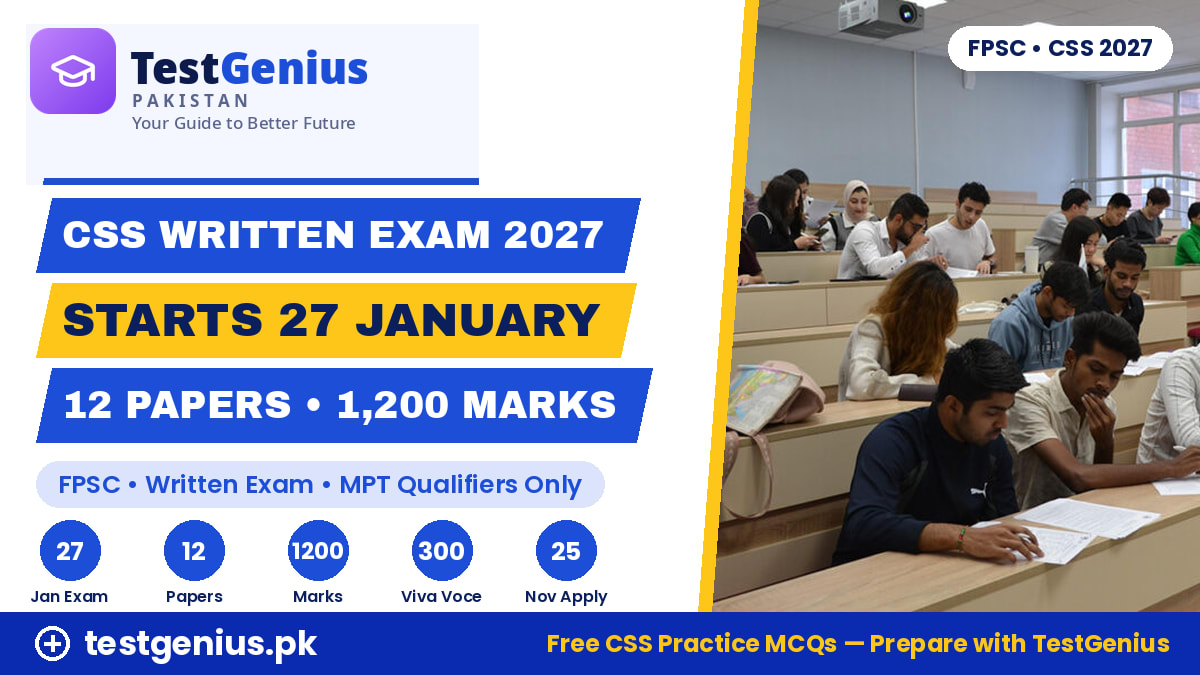
The CSS 2027 written exam starts on 27 January 2027 (tentative,
FPSC). MPT qualifiers apply online by 25 November 2026, with the hard copy due by 4 December. The written exam is 12 papers worth 1,200 marks — six compulsory papers (600) plus optional subjects (600) — followed by a 300-mark viva voce.
The dates that matter now
- The MPT screening test was held on 10 October 2026 and its result was announced on 4 November 2026. Only candidates who qualified the MPT can sit the written exam.
- Written-exam applications are open online from 10 to 25 November 2026, with a fee of Rs 2,200; the hard copy of the application must reach FPSC by 4 December 2026.
- The written examination begins on 27 January 2027, according to FPSC's Advance Public Notice No. F.2/1/2026-CE dated 5 July 2026. The date is tentative — FPSC has moved CSS dates before (the MPT itself moved from 27 September to 10 October), so confirm the final date sheet on fpsc.gov.pk.
- That leaves roughly nine weeks between the application deadline and the first paper: the plan in this article is built around those nine weeks.
12 papers, 1,200 marks: how the written exam is built
- Six compulsory papers, 100 marks each — 600 marks in total. Every candidate sits all six, whatever optional subjects they choose.
- Optional subjects worth exactly 600 marks, chosen from seven FPSC subject groups. Most candidates take six optional papers of 100 marks each, though the groups also allow 200-mark subjects — the rule is that the total must come to exactly 600, and the group rules decide which combinations are allowed.
- Each paper runs for three hours. Every paper except the English Essay carries 20 MCQs as part of its 100 marks (Mathematics optional papers are the exception).
- After the written papers comes the viva voce and psychological assessment, worth 300 marks — so the whole examination totals 1,500 marks.
- The syllabus framework has been unchanged since CE-2016; FPSC has notified no revision for the 2027 cycle, so material prepared for recent cycles still applies.
The six compulsory papers
- English Essay (100 marks): one essay, chosen from the topics FPSC sets on the day. No MCQs in this paper.
- English (Precis & Composition) (100 marks): precis writing, comprehension, grammar, vocabulary and sentence correction.
- General Science & Ability (100 marks): 20 MCQs plus an 80-mark subjective section testing everyday science, analytical reasoning and quantitative ability.
- Current Affairs (100 marks): Pakistan's domestic and external affairs and global issues, drawn largely from the twelve months before the exam.
- Pakistan Affairs (100 marks): the history, geography, economy and governance of Pakistan.
- Islamic Studies (100 marks), or Comparative Study of Major Religions for non-Muslim candidates.
Optional subjects: choose for scoring, not for comfort alone
- The seven groups run from Group I (one subject of 200 marks — Accountancy & Auditing, Economics, Computer Science, Political Science or International Relations) through the sciences, law, humanities, business and language groups. Read the group rules on fpsc.gov.pk before locking your choice: some combinations the groups forbid are the ones candidates assume are safe.
- Three things should decide the choice. First, overlap with what you already know — a subject from your degree, or one that repeats compulsory-paper material (History with Pakistan Affairs, International Relations with Current Affairs). Second, the length of its syllabus against the nine weeks left. Third, how much writing practice it needs — a 200-mark Group I subject is two papers' worth of preparation, not one.
- TestGenius carries free CSS practice subjects for several popular optionals — including Economics, History of Pakistan & India, Muslim Law & Jurisprudence, Philosophy, Journalism & Mass Communication and Anthropology — alongside the compulsory-paper subjects linked in this article.
Passing marks: the three bars you must clear
- 40% in each compulsory paper — 40 out of 100.
- 33% in each optional paper — 33 out of 100.
- 50% in the written aggregate — 600 out of 1,200 — to qualify for the interview stage.
- Clearing all three is necessary; clearing only two is not enough. A candidate who scores heavily in the optionals but falls below 40% in a single compulsory paper does not proceed.
- The two English papers are where most candidates fall short, so the plan below gives them the most weekly hours.
A 9-week plan for the time that is left
- Weeks 1–2 (foundation): finish choosing optionals and lock the combination. Read the compulsory syllabuses once, end to end, and list every topic you cannot yet write a page on. Start one essay and one precis every week from now — they cannot be crammed in the last fortnight.
- Weeks 3–5 (coverage): work through the compulsory papers in pairs — Current Affairs with Pakistan Affairs, General Science & Ability with Islamic Studies — and one optional at a time. Keep daily short notes on the news, the budget and foreign policy; Current Affairs rewards the last twelve months, not the last twelve days.
- Weeks 6–7 (writing): switch the balance from reading to writing. Sit two full three-hour papers a week under timed conditions, and mark them against the paper pattern. Daily MCQ practice on general knowledge, current affairs and reasoning is the highest-return habit in these weeks — 20 MCQs sit inside almost every paper. Practise with TestGenius:CSS MPT , CSS Current Affairs, General Knowledge , English, Pakistan Studies and Islamic Studies (links in the article).
- Weeks 8–9 (revision): stop starting new books. Re-read your own notes, re-attempt the timed papers you got wrong, and revise the essay outlines and precis techniques. In the final days, check the FPSC date sheet and your examination centre on fpsc.gov.pk, and keep your roll-number slip safe.
How to apply (MPT qualifiers only)
- Apply online on fpsc.gov.pk by 25 November 2026; the application fee is Rs 2,200. The hard copy must reach FPSC by 4 December 2026.
- Only candidates who qualified the MPT (result announced 4 November 2026) can apply — the written exam has no direct entry. The full application steps are in the earlier TestGenius guide linked in this article.
Comments
Loading comments…